
There’s no better place in the country than Las Vegas to bring together high–level sports executives from around the country for a meeting of the minds, as was the case last week when the second annual SEICon came to the Bellagio offering a wide variety of programming with some of the biggest names in the sports industry.
“This event is about bringing together thought leaders to educate and collaborate,” said Shawn Garrity, chief executive officer of Circle and executive producer of SEICon. “It’s bringing different people from different parts of the world together, who have different thoughts. And really having dynamic opportunities for people to interact and do great things. And we think we met our goals for this year and look to build upon that.”
For Las Vegas, which already hosts CES and IMEX each year and will host the Sports ETA Symposium in 2026, SEICon was a natural progression.
“The reason we’re having a conference like this is to create opportunities for us to diversify our economy and continue to grow,” said Shani Coleman, director of community and economic development for Clark County. “For example, we’re having conversations with people who are manufacturing different types of sports equipment and they want to do it in Las Vegas. And our goal is to make sure people know we have a great environment here not just for the sports teams to be successful, but the rest of our community to be successful.”
Public and Private Sector Collaboration
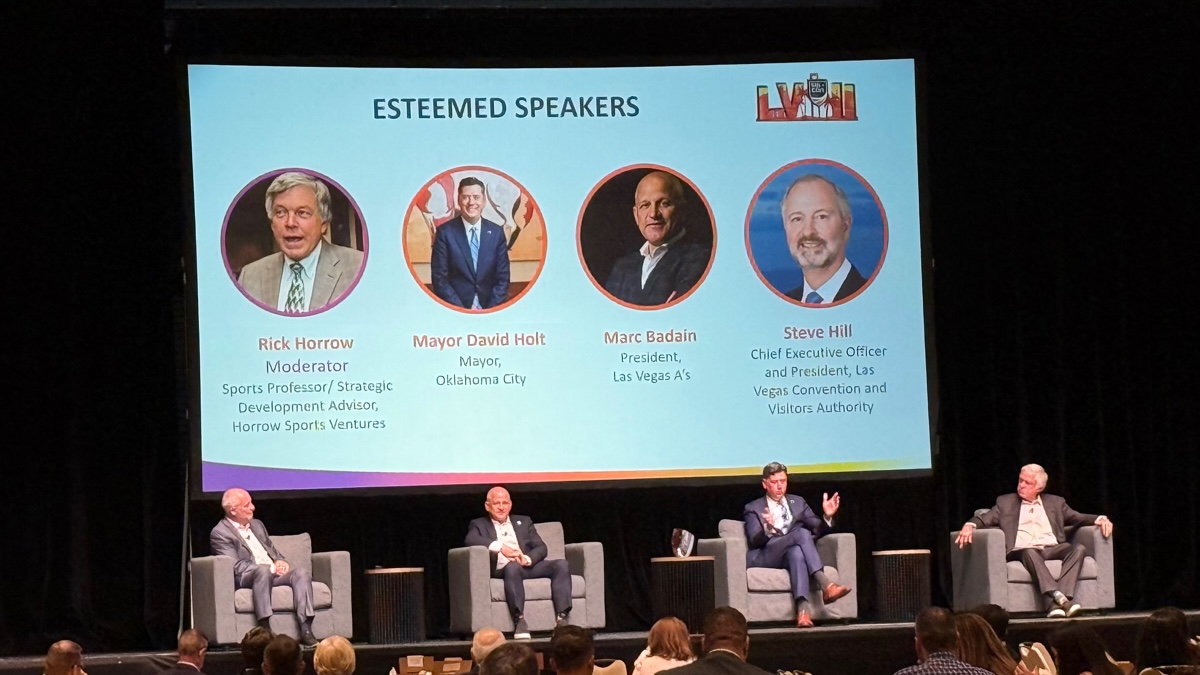
The keynote session, titled “Public and Private Sector Collaboration,” featured how sports and infrastructure rely on strong partnerships between the public and private sectors. The panel included Oklahoma City Mayor David Holt; Steve Hill, president and chief executive officer of Las Vegas Convention and Visitors Authority; and Marc Badain, president of the Athletics (soon to be Las Vegas A’s).
Holt spoke about Oklahoma City’s rise as a sports power, anchored by the reigning NBA Champion Thunder, Women’s College World Series and the upcoming 2028 Olympic Summer Games, which will see OKC hosting canoe slalom and softball. The city recently passed an important vote which allocates tax money toward the construction of a new arena for the Thunder, which will open in 2028 and keep the team in OKC until 2052.
“We’re the 42nd largest market in the country and there are 18 markets larger than us that don’t have an NBA team, including Las Vegas,” Holt said. “The citizens understood the stakes and were willing to say yes, with 71 percent of the vote to implement the tax. How you sell it to the people is critical — we saw it fail with the NHL in Tempe — so it’s special when you have voters who were willing to do it. In a free market, smaller cities have to pay more if they want to have the same things as Los Angeles and New York.”
Hill has seen Las Vegas explode in population and sports offerings in his more than three decades in the area. What once was a city without any professional sports teams now has three — Aces, Golden Knights and Raiders — with the A’s coming in 2028.
“Las Vegas is the easiest product in the world to sell. We’re a platform for events and sports teams, but really we’re a platform for people to come and make big ideas a reality,” Hill said. “The construction of Allegiant Stadium launched Las Vegas as a premier sports city. It’s allowed us to grow up and it changed the way the world looked at us, and now we host the world’s biggest events. I think we’re going to have a World Series here in the next 10 years and I also think we’re going to have an NBA team here in the next 10 years.”
Badain is confident that the A’s will draw big crowds in Las Vegas and create revenue for the city and the team. He points to the fact that 775,000 people come to Vegas as visiting fans during Raiders games last season.
“This market is made unlike other markets — it’s not always going to be on a spreadsheet,” Badain said. “You’re talking about visitation and tourism, so building stadiums like Allegiant and the ballpark we’re building here, it meshes perfectly. It also fits a part of the calendar when it’s slower in Las Vegas, so we’re bringing to Vegas what it needs, at the right time of the year. We’re building another special piece of infrastructure in the city.”
The Power of Sports Diplomacy
The session “The Power of Sports Diplomacy” explored how sports are shaping conversations across borders, from community outreach and policy influence to brand partnerships and cultural diplomacy.
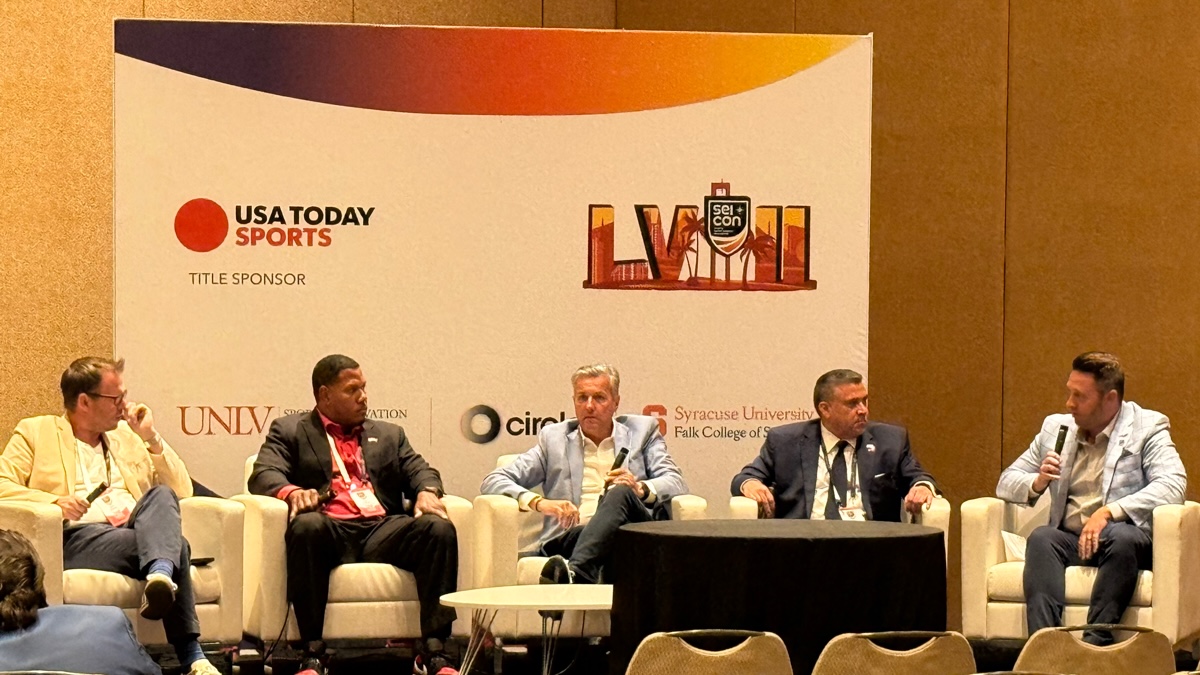
The panel featured Jay Vickers, UNLV Sports Innovation Institute; Martin Schlegel, Australian Sports Technologies Network; Joe Campos, Broad Bridge Capital; and Dedan Brozino, Rose Bowl Legacy Foundation & the Rose Bowl Stadium.
“Diplomacy has always been part of the sports ecosystem,” Vickers said. “It brings people together to have conversations, whether it’s to improve a situation, or deter a situation from getting worse. At the end of the day, we’re sports fans, not politicians. But we’re paying attention to what’s happening on the international scale, and we are aware of how it affects our state and our business.”
“Sports is the ultimate unifier,” Brozino added. “For 3–4 hours you can watch a game and be diplomatic and high five each other. We just hosted several Club World Cup games at the Rose Bowl and watching the fans from around the world interact was a special experience. Sports is a universal language and our stadium is still learning how to engage these fans from other countries, even at 102 years old.”
Schlegel points out in a digital age, the best business is still done face-to-face.
“You have to be actively in the market to participate in it,” Schlegel said. “You can’t just go through digital channels and in the end, you need to build personal relationships and be there in-person. That’s what we’re trying to do within the United States. It’s important to collaboratively solve problems. We have people working on Brisbane 2032 and they’re communicating with cities in America to learn what they’re doing around hosting big events.”
Campos says a post-Covid world has accelerated sports globally and expanded collaboration among organizations and countries.
“There’s such a voracious appetite for sports in general,” Campos said. “Sports is unique because there’s competition just like any other business, but everybody wants to put on the best events they can. It brings people together more than divides people. It used to be the big eat the small, but now it’s the fast who eat the slow.”
Trailblazing Women
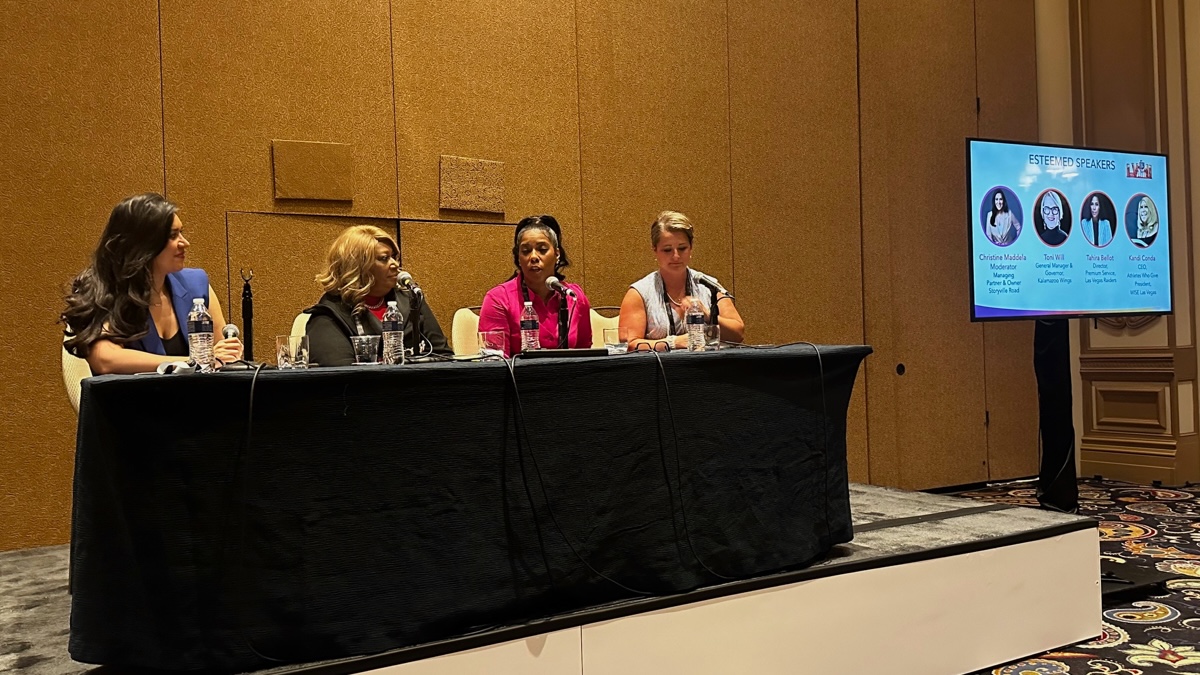
The session “Trailblazing Women in Sports and Entertainment” featured four women who have various roles in the sports world. Moderated by Christine Maddela, owner of production company Storyville Road, the panel featured Kandi Conda, the president of Women in Sports & Events; Tahira Bellot, director of premium service for the Las Vegas Raiders; and Toni Will, general manager and governor of the Kalamazoo Wings.
From pay equity and media representation to leadership roles and grassroots initiatives, the panel discussed how women are reshaping sports.
“A lot times we come through the door, but then we close it behind us,” Conda said. “We need to make sure we’re keeping that door open for the next generation of women. And we need men to understand that they are allies and we can’t do this without them. We want them alongside us, and we need them to help us with funding at the C-Suite level.”
Bellot spoke about how the struggle for women in sports sometimes comes from an unlikely source.
“Sometimes the biggest barrier is other women,” Bellot explained. “It’s not always done on purpose, but there’s a mentality about having to claw and fight your way to the top. We need to invite people to the table and help and teach them, not be a barrier. If I can’t be in the space, I can’t learn and can’t grow.”
“There’s enough room for everybody on the bus,” Will added. “Sometimes you have to create your own seat. You reach out to the experts, you learn and challenge yourself to go away from the scarcity mindset.”






 Copyright © 2025 by Northstar Travel Media LLC. All Rights Reserved. 301 Route 17 N, Suite 1150, Rutherford, NJ 07070 USA | Telephone: (201) 902-2000