Letter from Colorado Springs: The Impact of the U.S. Senior Open
How major sports events are uniting a city's economy
Posted On: July 8, 2025 By :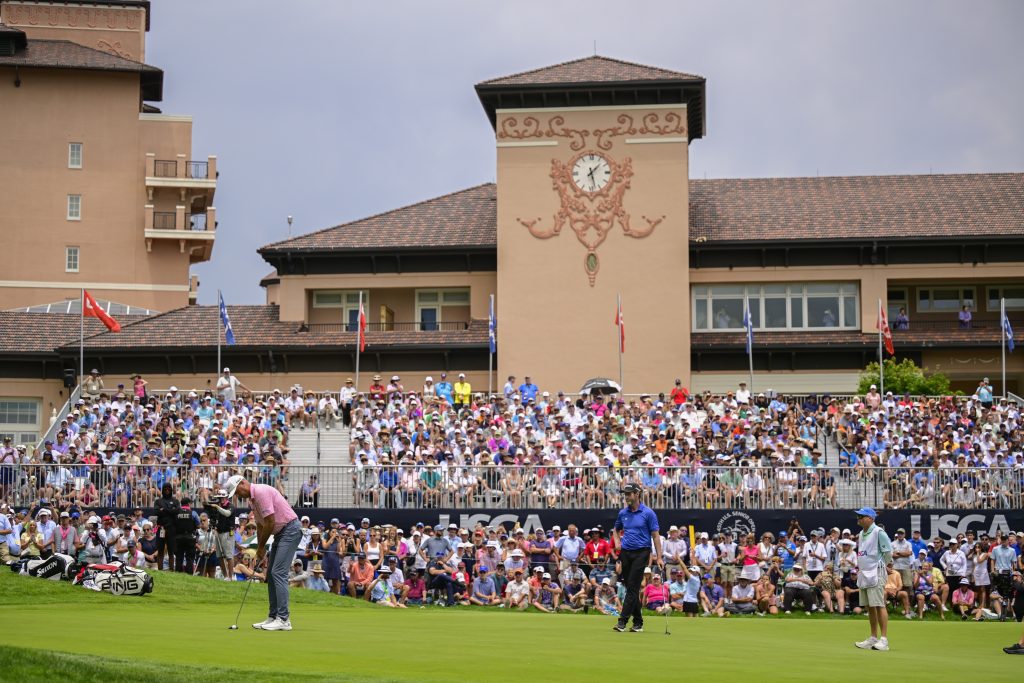
There were signs early on that I might be destined to become publisher of SportsTravel. One of those signs was that I always had a thing for sports events, even if they were ones I organized in my room.
While I didn’t play golf growing up, I at least played mini golf. And somewhere along the line, our family had acquired a golf putter, which was the only club we had in the house. As a kid of about 10 years old, I would use that putter to create “golf tournaments” in the upper floor of my childhood home, carving out a course with that putter, a golf ball and a Dixie cup as the hole. And to make it seem real, I would assign each stroke to a player on the real PGA Tour, keeping a spreadsheet of everyone’s score as I went along the course to see who won. It was nerdy sports stuff but I enjoyed thinking that Jack Nicklaus, Gary Player, Fred Couples or Bernhard Langer were playing my home course, including the signature Hole No. 5 from down the hallway, to the door of my bedroom to the tricky hole placement between my bed and dresser, a tough par-2.
Those childhood tournaments were in the back of my mind as I recently had the chance to spend the opening round at the USGA’s U.S. Senior Open at the historic Broadmoor hotel and resort in Colorado Springs. It was the venerable venue’s third time hosting the championship, which is open to golfers age 50 and above. And what a treat to see the actual Bernhard Langer — winner of two Masters, as well as a few of my childhood tournaments — tee off and putt in real life at age 67.
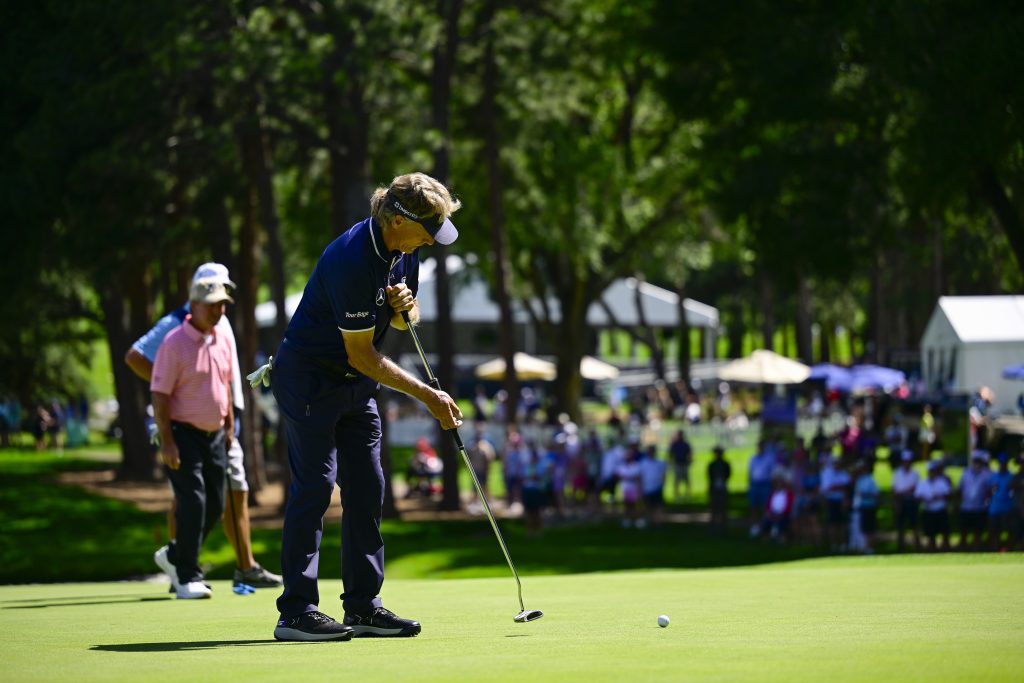
It’s that nostalgia that feeds the Senior Open, the chance to see former favorites still at it and on the course. But the event — particularly in Colorado Springs — has proven more than a step back in time. It’s a step up in economic impact, a great case study on a destination leaning into big moments to make the case for the economy of major sports events and a larger sports culture.
Steeped in History
The Broadmoor is no stranger to big events. In its 107-year history, the resort at the base of the Rocky Mountains has hosted nine USGA championships, including the 1959 U.S. Amateur where a 19-year-old Nicklaus won his first tournament (and years before his other crowning glory winning one of my childhood hallway championships …). The Broadmoor was also the site where LPGA Hall of Famer Annika Sorenstam won the 1995 U.S. Women’s Open, her first LPGA victory.
But the U.S. Senior Open is also no stranger, having come to the mountainside resort in 2008 and 2018. In addition to the 2025 event, the USGA has announced it plans to return in 2031 and in 2037. That place in the rotation means a lot to the resort as Jack Damioli, the Broadmoor’s president and chief executive officer, told me during a chat in his office as the event teed off.
“Being in the rotation every six years is something that we would love to be able to continue and it’s just part of the golf history, the history of the Broadmoor and what makes the Broadmoor kind of special,” he said.
Hosting the event is no small feat for Damioli’s staff of more than 2,000 employees whose hospitality has become legendary in the travel industry. Combined with more than 1,700 volunteers on site for the events, the logistics of getting those people around was substantial.
“This takes a lot of coordination, a lot of behind-the-scenes efforts,” he said. “Three years ago, we started planning, selling sponsorships, getting the administrative pieces together with security and all those type of orchestrations that have to happen. That includes shuttling services, where volunteers park, where patrons park, how do we interface with a resort that has 784 guest rooms and all those type of things.”
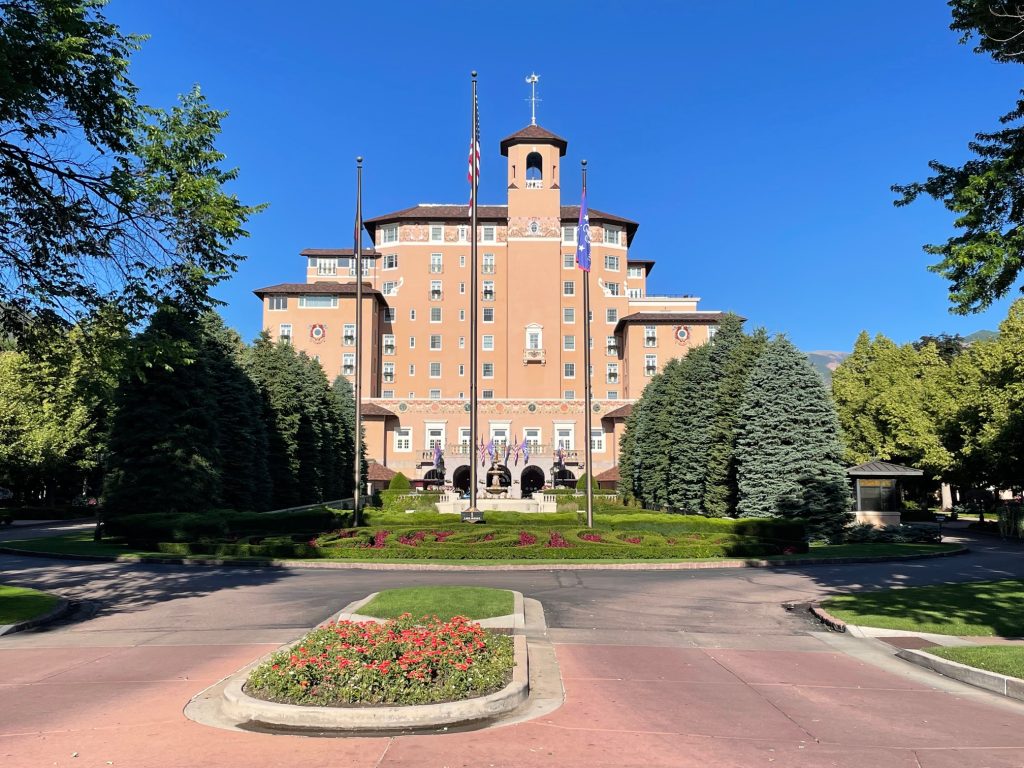
Despite those logistics, the effort is worth it, even if the bottom-line impact is in the long term.
“Financially, this is kind of a break even for us,” Damioli said. “We may make a small profit, but this is not a windfall by any means. But it is something from a marketing perspective that’s priceless. If you think about 20 hours on television, Thursday and Friday on Golf Channel, and then 12 p.m. to 4 p.m. over the weekend on NBC — you can’t afford to buy that. As an independent hotel and resort, you can’t afford to buy that kind of TV time.”
While Damioli likes being in the rotation for the event, the USGA also likes returning for the built-in advantages the resort provides. As Julia Pine, the USGA’s director of championship communications and content, explained to me, while the USGA maintains “anchor sites” for the rotation of the regular U.S. Open, other championships like the Senior Open typically don’t work the same way.
“We don’t use that term officially for the Senior Open, but this is as close as we get,” she said of the Broadmoor. “Internally we will say the Broadmoor has turned into a bit of an anchor site for the Senior Open and we have this commitment to come back every five, six years.”
Driving that commitment are some efficiencies that a resort destination provides, including infrastructure the USGA doesn’t have to build anew as it would at other courses. Facilities are there to help with housing, food and beverage, even viewing areas.
“When we go to some typical country clubs or golf courses, we basically have to build a small city,” Pine said. “But at the Broadmoor, we’re able to utilize so many of their hardscape facilities that there are some cost savings from a build perspective for us, so that’s another benefit to being somewhere that has the sort of infrastructure that the Broadmoor has.”
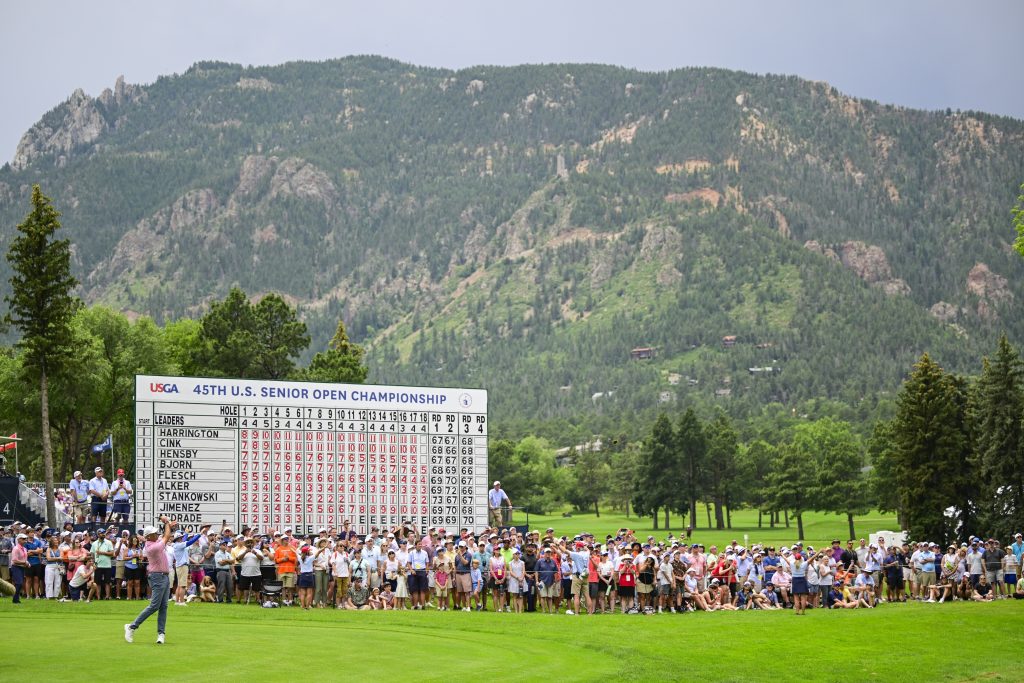
And it doesn’t hurt that the venue has stunning views tucked alongside a mountain and provides a place that players and their families want to visit. Fans clearly want to visit, too. Of the 12,000 fans per day that came during the ticketed Wednesday through Sunday, less than half — 46 percent — came from Colorado Springs. Another 32 percent came from the Denver market with the remainder from outside of the region.
Overall, the tournament was expected to generate an estimated $24 million in economic impact.
An Event with Record Impact
Those numbers are music to the ears of the city’s hospitality community.
As players teed off on the opening Thursday, I got some time in the Broadmoor’s west lobby with Doug Price, the president and chief executive officer of Visit Colorado Springs. And one of the first facts he shared with me explains why a city wants this kind of business from sports: In 2018, the last time the U.S. Senior Open was in town, the week resulted in the largest sales tax generation the city of Colorado Springs has ever experienced for any event, sports or otherwise.
“Not only was the hotel occupancy up, but for a city that depends on sales tax, the amount of food and beverage and gasoline and all the things that get purchased that week, you couldn’t replace it,” he said. “For a city that’s not a tier one city — we’re not Denver who gets all these sporting events — for us, we see the spike in a big, big way. And then you factor in NBC and the Golf Channel and Peacock with 20 hours of live coverage, it just puts us in a different league for a week.”
Or put another way: “This is brand enhancement on steroids for us,” he said. “It’s terrific.”
In addition to the CVB, Colorado Springs has an active sports commission that was also involved in efforts during the week. Over breakfast in the Broadmoor’s main dining room — where the city’s power brokers have dined for generations — Davis Tutt, the senior director of sports tourism and Olympic engagement for the Colorado Springs Sports Corp, emphasized many of the same points.
“The USGA is an international brand and they are pushing out the Broadmoor to markets around the world,” he noted, “showing the landscape that’s here and the property that is the Broadmoor. They show our city very well.”
The announced return in upcoming years was also indicative of the trust the USGA has in the city’s approach to sports, he said.
“Obviously with it coming back in ’31 and ’37, the USGA recognized that ticket sales are good and solid,” Tutt said. “It’s a show that they want to keep bringing this back and putting it on.”
And with NBC being the broadcasters of the event as well as the broadcaster for the Olympic and Paralympic Games in the United States, the chance was there as well to do some promotion for the upcoming 2026 Olympic and Paralympic Games from the city that serves as headquarters of the U.S. Olympic and Paralympic Committee.
Promoting Around a Brand
While Colorado Springs has its traditional hospitality community to support big events such as the U.S. Senior Open, other efforts at economic development are at play in town as well, drafting off the success and impact that sports event like these have.
Colorado Springs has been investing in sports for years. Its original founder, William Jackson Palmer, even put an emphasis on health and well-being when the city was launched in 1871. In more recent times, Colorado Springs made the game-changing play in 1978 to attract the U.S. Olympic Committee to move its headquarters there. That move has produced an entire economy for the Olympic and Paralympic movement, which has more than 25 national governing bodies located in town.
But “Olympic City USA” as they call themselves has been expanding in recent years beyond that podium pedigree. The 3,400-seat Ed Robson Arena opened in 2021 at Colorado College, as did the 8,000-seat Weidner Field, a soccer stadium south of downtown that is home to the USL Switchbacks. Plans are in the works for a potential new indoor/outdoor youth sports complex.
With all that economy at play, the city also has a new effort to unite business forces to draft off the success of events such as the U.S. Senior Open, as well as those new venues. Source Colorado Springs is a new effort from the city’s chamber of commerce to unite different forces in the city for purposes of economic development, based on a similar program that has proven successful in Cincinnati to elevate its national profile.
Over lunch at the Broadmoor’s Golden Bee (where waitresses fling bee-shaped stickers at patrons who wear them proudly during their meal and the rest of the day), Jayne Mhono Dickey, the group’s executive director, explained what’s happening. While “Olympic City USA” is one brand the city promotes, it also wants to position itself as friendly for the outdoors, as a place for business, as a destination that supports technology and more.
“We established Source Colorado Springs to help tell the Colorado Springs story nationally,” she said. “The program is structured in a way that collaborates with all organizations that are locally based be it Visit Colorado Springs, the Colorado Springs Sports Corp, the arts industry, key primary employers like aerospace and investment, manufacturing, cyber security — we’re trying to work as a link to all these entities. We want to harmonize all these brands, find a common brand that truly represents us as a region, so we can be able to sell ourselves nationally and globally. And the Senior Open is one of those elements.”
That kind of coordination and partnership may pay other dividends locally as well.
From his office in the Broadmoor, Damioli said groups such as the USGA take note when they see the local community support a bid and the execution of a sports event.
“As we think about what goes into a decision to return or to book a location, the city government, the state government is very important,” he said. “So, support from the Colorado Tourism Office, support from El Paso County, support from the city of Colorado Springs is very important and the USGA looks at that, and they want to make sure that they’re welcome into the city that they’re going into and that everybody’s aligned with the vision that this is something that’s going to be good for the community.”
The Master Plan
All of which brings us back to the golf.
When all was said and done, Irishman Padraig Harrington took home this year’s U.S. Senior Open crown, securing the win on the final hole on the final day over Stewart Cink. Asked at the end what he thought of the experience, Harrington put an exclamation point on what local leaders were hoping would be the case.
“I just really enjoyed the experience here at The Broadmoor,” said Harrington. “Right from the start, you’d be surprised … sometimes we stay in very average places because it’s near the [event]. Here we’re staying in a beautiful hotel. It just settles you down for the week. Everything about it, being on site, which made it very easy, it just was a very nice, comfortable week.
“Look, I’m here working this week. I think there’s nobody that wouldn’t come here on a holiday.”
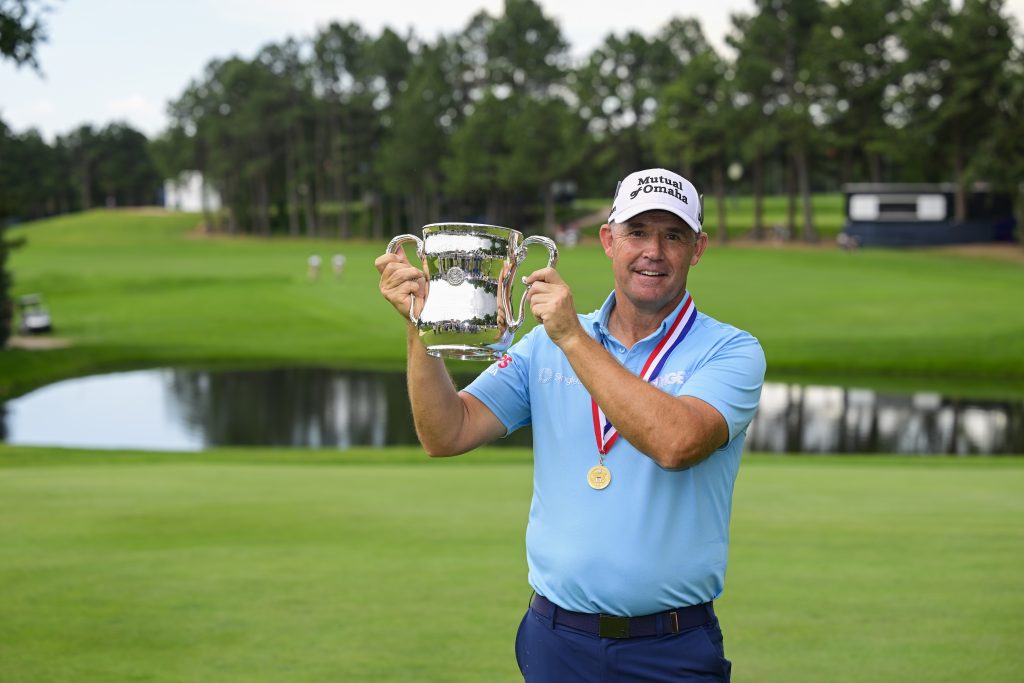
For leaders like Price, that kind of sentiment put a cap on the reason sports events and sports tourism are so important to destinations like Colorado Springs.
“I just have to remind myself that when General Palmer founded this city, it was it was on health and wellness,” he said. “It was for people with tuberculosis to come here for the sunshine and to get healthy. So, before there was a term called medical tourism, General Palmer already knew that this would be a place that people would come to enjoy themselves and to get healthy. And so the way it’s worked out, you know, 154 years later, it’s kind of remarkable how the master planning for this city continues.”
For sports fans like me, the opportunity to see our childhood heroes was an added bonus as well. Seeing the impact an event like the U.S. Senior Open has on a city like Colorado Springs was as satisfying as sinking that par-2 putt in my hallway years ago.
And seeing the actual Bernhard Langer play in person? Even better.

Jason Gewirtz is vice president and managing director of the Northstar Meetings Group Sports Division and the publisher of SportsTravel.
Posted in: Golf, Jason Gewirtz: From the Editor, Main Feature, Perspectives