In Tampa, Teamwork Keeps Rays in Town
Destination has more than MLB, however, with a vibrant youth sports scene
Posted On: July 15, 2025 By :The crowd started to stir on this early June night in Florida as dark clouds gathered over the field. Rain started, slowly and then more steadily and harder, as those in the crowd began to take shelter under the concourses.
There was also a nervous energy for when — not if in this case — the umpires would call for a rain delay. Because on this night, against the visiting Texas Rangers, the Tampa Bay Rays and its fans were about to experience a first for the franchise: A regular season rain delay.
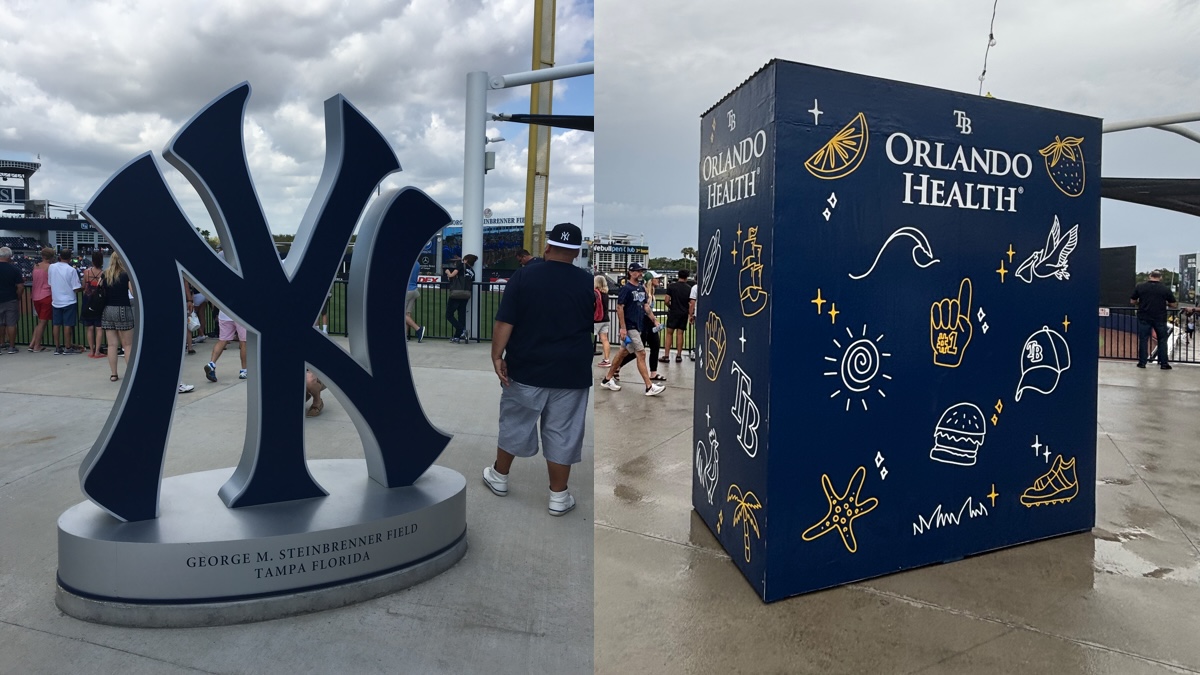
The Rays are playing this season’s home games across Tampa Bay at the New York Yankees’ spring training home of Steinbrenner Field, because Tropicana Field in St. Petersburg was severely damaged by Hurricane Milton. The Rays’ home since 1998, the fabric roof over Tropicana Field was ripped to shreds after Hurricane Milton came ashore, bringing wind gusts exceeding 100 mph and flooding parts of Florida.
At about 11,000 seats, Steinbrenner Field is the largest spring training site in Florida. That the Rays stayed in market and did not go elsewhere to play is the reverse of what the Athletics are currently doing in California, or what the Toronto Blue Jays did during the pandemic (including a season in Florida).
“Any time you’re fortunate enough to have a professional franchise in your market, you want to do everything to keep them there because of what it represents and means to your community,” said Jason Aughey, senior vice president of sports tourism for the Tampa Bay Sports Commission. “That partners like the Yankees were able to make it happen says a lot about them and the way that the community has rallied and come together under the circumstances says a lot about the grit and togetherness of what Team Tampa Bay is all about.”
The Rays’ saga has dragged on for years and the news about a potential ownership change, with the tentative plan to return to the Trop next year, looms over fans. Yet in this region that abuts the Gulf of Mexico, there is way, way more than baseball.
All Pulling Together
Yes, Tampa has a reputation for major sporting events on both the collegiate and professional levels; five Super Bowls (including the famous pandemic event), the 1999 NCAA Men’s Basketball Final Four and this past season’s Women’s Final Four (one year after hosting the NCAA Volleyball Championships). It’s been home in the past year to a preseason MLS game featuring Lionel Messi, four nights of WWE and will host the 2027 and 2028 American Athletic Conference men’s basketball tournaments.
But like many markets, what can move economic impact equally as much is the 97 youth and amateur events Tampa hosted last year. In November 2024, the Red Bull Flugtag attracted nearly 100,000 people to the Tampa Convention Center. More than 20,000 cheerleaders descended upon downtown for a recent Varsity Spirit competition.
“There’s no denying the profound economic impact that comes from hosting these events,” Aughey said. “We find that a lot of families turn their trip into a vacation because of all we have to offer away from the fields or off the court. When you see all these people staying in hotels, eating at restaurants and visiting attractions, there is an intrinsic value derived from knowing that your organization played a direct role in helping bring them to Tampa.”

The Tournament SportsPlex of Tampa Bay, a county owned and operated facility, opened in November 2018 after a six-year process from proposal to approval to groundbreaking. The complex, which has 15 full-size soccer fields that can be adapted to as many as 54 flag football fields, is a special event complex that keeps its schedule to around 25 events per year at most to keep the fields from being overused.
Stephen Reed, vice president of the Sportsplex, said that more than 90% of what the complex hosts is youth events. “We don’t want it to be run down,” he said. “Having the outside partnership with the county has helped tremendously to keep the status of the fields and the status of the complex up.”
The SportsPlex’s location with a 20-minute drive between downtown and the Tampa Bay International Airport means there can be up to 10,000 hotel rooms available for tournaments (the region overall has approximately 26,000 hotel rooms). With three operations employees and five maintenance people to maintain the quality of the fields, the SportsPlex is able to serve as almost a one-stop shop for event organizers.
“We’ve gone from a lot of smaller local and regional events to more nationwide events,” Reed said. “Our scheduling has become easier because a lot of these groups want to come back here after year, so it makes it a lot easier for us just to roll to the next year.”
Seven years on from its opening, the SportsPlex has developed new parts within its facility. There’s been a building for locker rooms and extra shade for teams constructed and in addition to a concession area, food trucks will come to the venue to help feed athletes and families during big tournaments. There’s also meeting room space and a vendor building for event organizers who are selling merchandise during an event, Reed said.
“When you’re bringing in these events and giving local kids and coaches the opportunity to participate and experience events that are truly the best of the best, it raises the profile for people in the market and generates a tremendous sense of pride,” Aughey said.
Catching Rays Outside
On the night of this first regular season rain delay, it didn’t last long as a matter of fact. And when the Rays’ ground crew rolled the tarp back up, the scoreboard in left field kept track of the time needed — just under one minute, impressive given that before this season only two people on the grounds crew had ever pulled a tarp.
“The biggest difference is that during spring training, you typically gets cold fronts that come down so you can kind of really gauge when to put the tarp on,” said one of those people, Dan Moeller, director of special project and field operations for the Rays. “(Today), you’ve got those pop up storms and you can pull the tarp anytime.”
Playing outside means more time for Moeller on his phone — “I spend a lot of time looking at different (weather) apps on my phone. And it’s almost like every single app has a different story to tell.” But being outside means more than just needing to pull a tarp during a weather delay.
The Rays’ ground crew has worked to change how the grass is cut, especially in the outfield, as the regular season has gone on. Even more than that is the infield dirt, which is more of a clay-based surface.
“The infielders really didn’t like the clay that was in here, which is more of a spring training type clay,” Moeller said. “So we changed out the clay to give them more of a feel like the Trop.”
Watering the field also means new challenges for the Rays’ ground crew. Before, there was the consistent conditions of indoors at the Trop. Now with the changing conditions of outdoors, Moeller relies on player feedback.
“We’ll go out and talk to the players like during batting practice, try and get their feedback and tweak things as we go along,” he said. “And then, of course, having day games, that’s a totally different animal because it doesn’t matter how much water we put on the field at game time — by the third or fourth inning, it’s like a concrete out there. So it’s difficult to deal with in that respect, the day games and night games. And now that we’re coming into the rainy season, it’s going to be a whole another tweak to it.”
Tweaking how things are presented is something that Warren Hypes, vice president, creative and brand for the Rays, knows all too well this season. Steinbrenner Field looks and feels like the Rays’ home ballpark this season but it was nothing but easy in doing so. There was months of measuring the entire ballpark and working with the Yankees in knowing the dimensions needed for wall coverings, flags, advertising billboards — and then four days between the end of spring training and the start of the season to wrap the stadium in gold and blue.
“I don’t think the adrenaline stopped through those four days or even through the first homestand here,” Hypes said. “We all put so much into it and for on Opening Day to see how it went and to see the fans’ reaction to be able to do things outside — we don’t normally do flyovers and fireworks — it’s been really special and definitely a season I’ll never forget.”
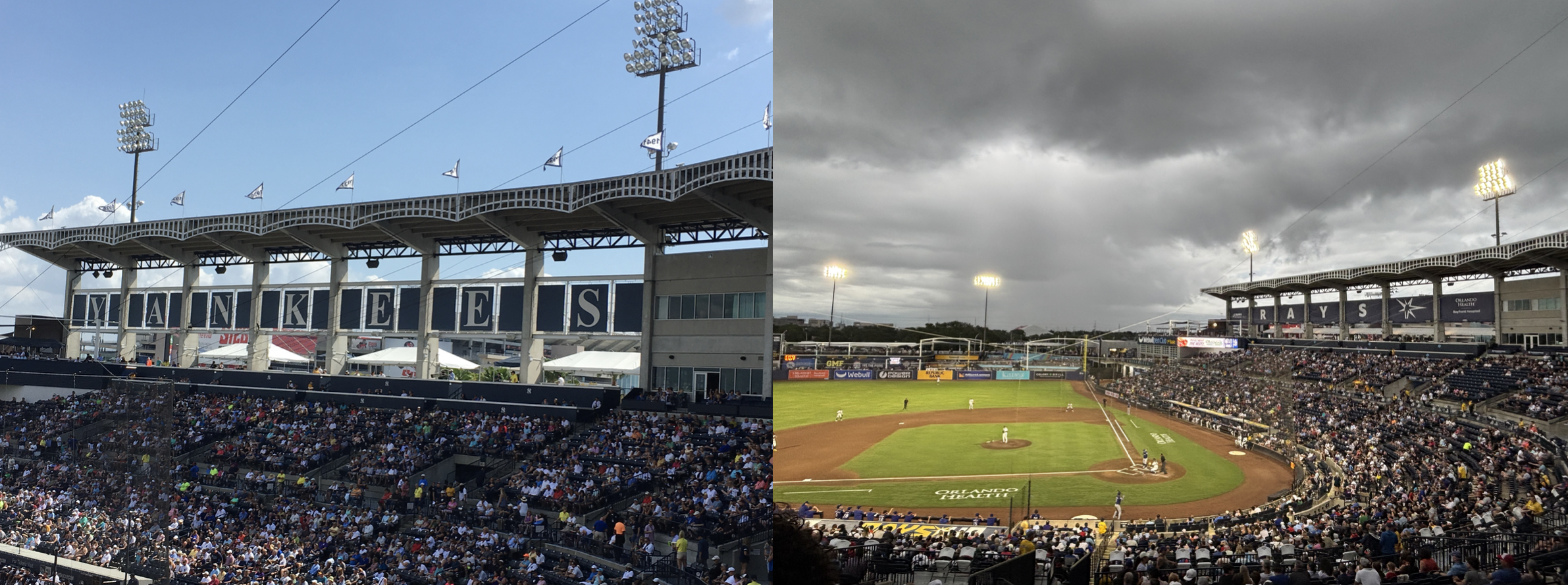
The Rays worked with five different signage vendors to wrap the ballpark and 50 installers from those vendors, Hypes said, as well as several hundred team employees who volunteered time to do everything from putting Rays stickers on walls to going to the outfield wall with sponges and brushes to clean the walls of dirt before new sponsorship banners could be overlaid.
“Going into every season, you may have changes on the roster or different partners or whatnot,” Hypes said. “But to do it on this scale and with this kind of timeline and to work with a partner — it wasn’t our building that we could just do whatever we want, so the partnership aspect of it with the Yankees is super important. To this magnitude it’s the biggest project in my career.”
This project will be more than just one year’s worth of experiences for the Rays. Between not just the look at the ballpark but the digital assets on video boards and marketing campaigns, there are new ideas and presentations that could be transferred back to the old stadium for next year.
“I think anytime you do something challenging in your career and you get through it, it makes you better,” Hypes said. “You definitely have experiences from it that make you better. It make you learn new things. So that’s super important.”
Sooner or later, the attention for the Rays — playoff appearance notwithstanding — will turn to next year and the proposed return to the Trop, with lessons learned about dressing the facility with a new look. There will also be another youth event at the SportsPlex, the 2026 NHL Stadium Series or another update on the University of South Florida’s on-campus football stadium or more cheerleading at the convention center. It’s part of the mix that the region delivers for a sports market that appreciates what it in town but also are anticipating what’s next.
“Whether it’s coming out supporting a special event or contributing to record attendance at an NCAA championship, this is an engaged community where people are always looking for something to do,” Aughey said. “People always ask what’s next because that’s the expectation here — in looking ahead, there are a ton of exciting announcements on the horizon.”
Posted in: Major League Baseball, Sports Venues